

what kind of paint to use on canvas
Yes, you can paint on unstretched canvas. I will show you:
- an EASY way to paint on unstretched canvas.
- TWO ways to prepare the unstretched canvas for framing.
Using the right canvas
I recommend using primed linen or cotton canvas. You can buy cotton or linen canvas by the yard at an art supply store or you can get it online at one of the art supply houses. There are a lot of choices, you can get it primed or unprimed. I buy the primed linen canvas.
Priming your own canvas can be messy and time consuming but I've done it and wrote about how and why to prime your own canvas.
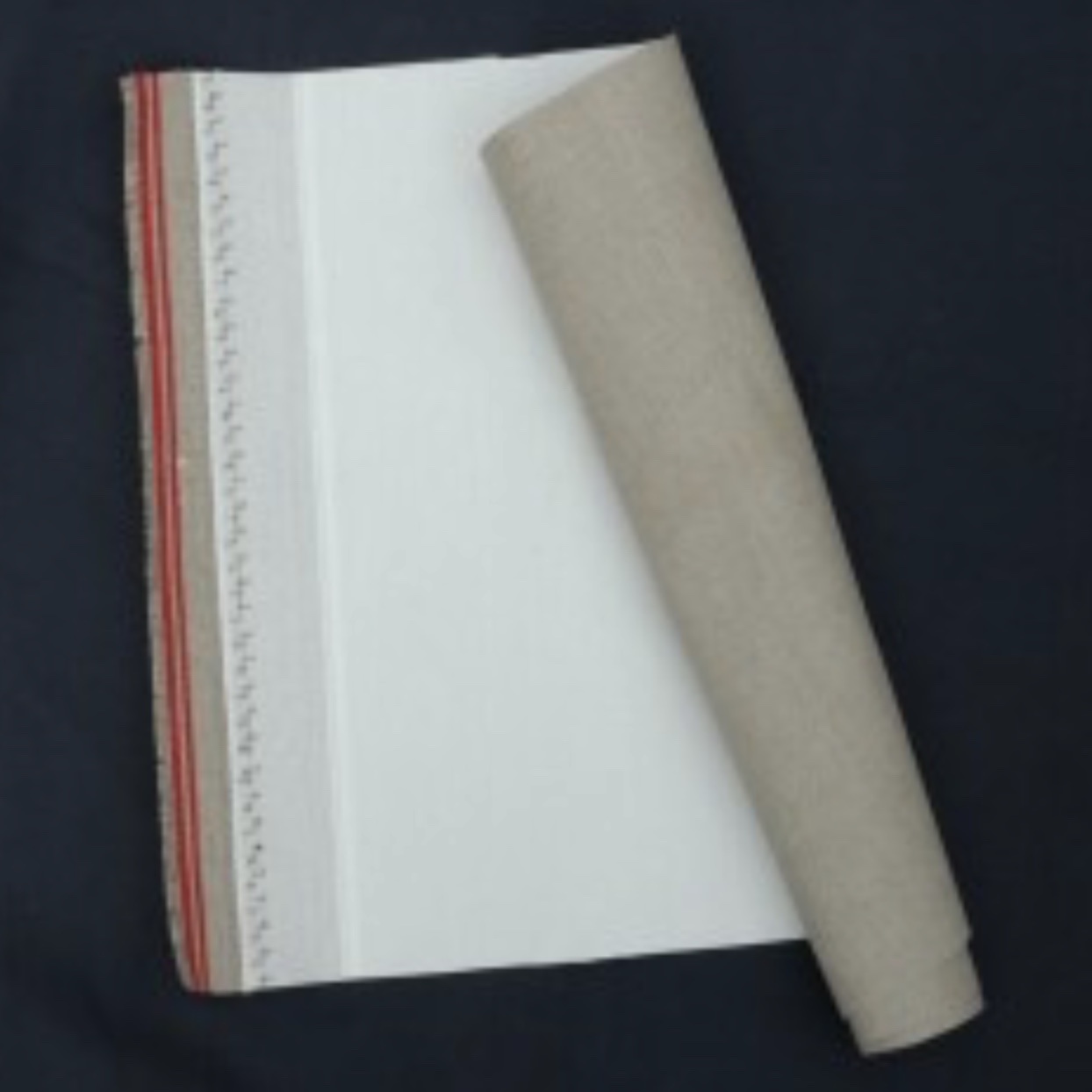
The photo above is of some primed linen canvas. You can see the natural unprimed side and the primed white side. You just cut it to the size you want with ordinary kitchen scissors. I use a straight edge and a pencil to make straight marks before I start cutting. The linen canvas isn't cheap, I think it costs something like $45 a yard, but it's 54″ wide.
Preparing the unstretched canvas
Okay, now that you've got your nice cut piece of canvas, what to do with it? You have two choices.
1. Glue the canvas to a support
You can easily and quickly tape your cut piece of unstretched canvas to a piece of foamcore and paint your subject.
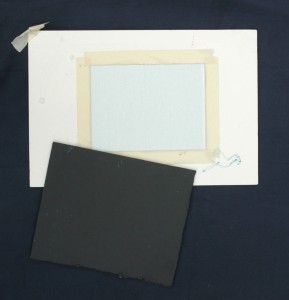
That's what I've been doing lately. That way if I don't like my painting, it's no big loss. Above is a rectangular piece of canvas taped to some white foamcore. Foamcore also comes in black. You could conceivably use anything that is rigid, a couple of days ago I used a big piece of cardboard for the painting I did in art class. You can see how I use this method of painting on unstretched canvas here.
Lesley Rich
I learned about cutting canvas and taping it to foamcore from Lesley Rich. She cuts a bunch of canvases in various sizes and takes them along when she travels. There isn't much weight involved and they don't take up much room. Once the paintings are dry, you can just stack them up and they hardly take up any room at all in a suitcase.
Trimming the canvas
If you plan to paint a bunch of 6″x6″ paintings, you'll have to cut your canvas 6 1/2″ x 6 1/2″ to allow for that little 1/4″ that gets hidden behind the frame. I cover as little of the canvas as possible with tape, that way I can paint almost to the edge of the canvas.
Adhering the canvas to a support
When I'm finished with my painting, it's dry, and I like it well enough that I didn't throw it in the trash, then it's time to get it ready to frame. At this point I can make it just about any size I want by cutting off the parts I don't want IF I'm planning on glueing it to a support. Just remember to leave that 1/4″ that'll be covered by the edge of the frame.
I use YES! paste and brown MDF sheets. I think you could use foamcore or similar materials but you probably want them to be archival or acid-free. One disadvantage to using such a rigid support is that you have to have a way to cut it (a saw).
I use a brush and put the glue on the backside of my painting, then stick it on the support. I use a brayer (roller type) to make sure there are no air bubbles and the canvas is flat. This YES! paste is very thick though and I had to add some water to get it thin enough to spread. The YES! paste is a great product and has many other applications around the house.
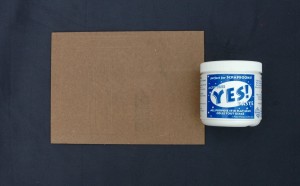
After the canvas is glued to the support, I would wait a few days and then varnish the painting, then take it to the framer when the varnish is dry.
Below I have links to everything you need to make this method work. This is what I do because I find it easier than stretching canvas!
As an Amazon Associate, I may earn a small commission at no cost to you if you purchase a product I linked to. This helps me with the cost of running this website. Thank you!
2. Stretching your own canvas onto stretcher bars
The other way to paint on unstretched canvas, which to me is more complicated, is to stretch the canvas across stretcher bars.
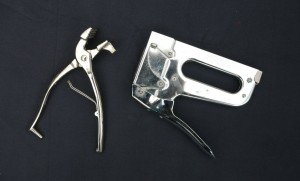
Stretcher bars are available at art stores for around $1 each. You have to put them together at the corners, they just have notches that fit together, BUT you have to keep those corners at 90 degree angles. You need two pieces of equipment shown below. The "grabber" thing to really grab the canvas and pull it around the backside of the stretcher bars. Then, while stretching the canvas taught, you'll need to use the staple gun to secure the canvas to the back of the stretcher bars. At our local art store there are stacks of xeroxed instructions on how to do this.
Important – if you plan to stretch your canvas, you need to leave a lot more canvas around your painting. A 6″x6″ painting will probably need to be on about a 12″x12″ piece of canvas.
Below I'll link what you need to stretch your own canvas. You'll need to get the stretcher bars in the SIZES you want, and I recommend the stretcher bars that are 3/4″ thick. They also come in 1 1/2″ but that's for "gallery wrapped" where the canvas edges are usually visible.
Once you have your canvas stretched, and the corners are all squared up, then you varnish the painting, let that dry, and take it to the framer.
Why paint on unstretched canvas?
For me there are three reasons to use unstretched canvas:
1. I can cut a bunch of rectagular sizes and if I don't like what I did, it's easy to throw away. Great for small sudies.
2. It gives me some flexibility with the composition. If I decide I have too much sky on a landscape, it's easy to get stretcher bars a little shorter or cut off that part and glue it to a smaller support.
3. Lightweight and space saving. Paintings on unstretched canvas are easy to store, they can always be mounted to a support and framed later. Or not.
I think stretching canvas is one big pain and I would much rather glue my canvas to a support, but that's me. Most of the time I paint on prestreched canvas or canvas already glued to a support that I buy on-line from SourceTek. Source Tek has a lot of sales so if you get on their mailing list they will notify you.
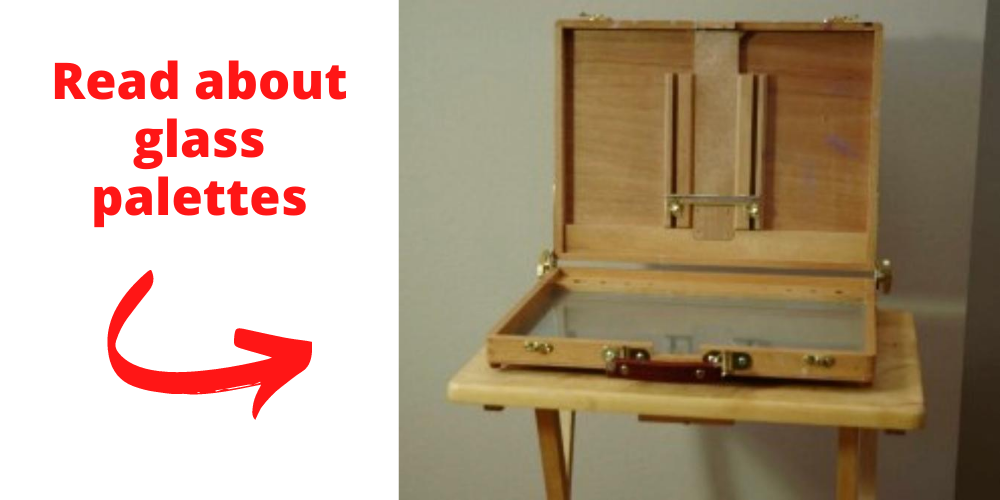
If you enjoyed this post you might find my post on glass palettes helpful. Thank you! Joan
what kind of paint to use on canvas
Source: https://joanbreckwoldt.com/2009/02/two-methods-for-using-unstretched-canvas/
Posted by: browntheared.blogspot.com
0 Response to "what kind of paint to use on canvas"
Post a Comment